
Implementing robust BPO business continuity Philippines frameworks has become a non-negotiable imperative for Fortune 500 enterprises, multinational financial institutions, and global healthcare networks. In an interconnected, digital-first economy, customer support lines, revenue cycle operations, and critical IT helpdesks must function uninterrupted. Unplanned outages, network disruptions, or extreme weather events do not merely delay operational tasks; they trigger severe contractual penalties, damage brand reputation, and erode enterprise market capitalization.
Managing enterprise risk requires moving beyond basic emergency checklists. Global organizations evaluating offshore delivery locations must assess how vendor infrastructure withstands regional disruptions while maintaining zero-downtime service level agreements (SLAs).
To achieve operational resilience, leading global enterprises partner with mature outsourcing providers that deploy sophisticated disaster recovery protocols, automated cloud failover systems, and multi-city geographic site redundancies. Here is an in-depth analysis of how enterprise-grade continuity planning across the Philippine archipelago guarantees uninterrupted service delivery.
1. The Anatomy of Modern Business Continuity in Enterprise Outsourcing
Enterprise business continuity planning (BCP) encompasses the policies, automated systems, and operational backups designed to keep mission-critical workflows operational during sudden disruptions. Unlike localized office closures where teams wait for power or network restoration, global enterprise BCP requires instantaneous recovery protocols.
Two foundational metrics govern enterprise disaster recovery frameworks: Recovery Time Objective (RTO) and Recovery Point Objective (RPO). For critical tier-1 processes—such as emergency healthcare intake, fraud detection, and transactional banking support—enterprises mandate near-zero RTO and RPO benchmarks.
According to research from Gartner on business continuity management, enterprise organizations that integrate dynamic continuity planning with cloud infrastructure reduce operational disruption impact by more than 70% while improving regulatory audit readiness.
Key components of an enterprise-grade continuity architecture include:
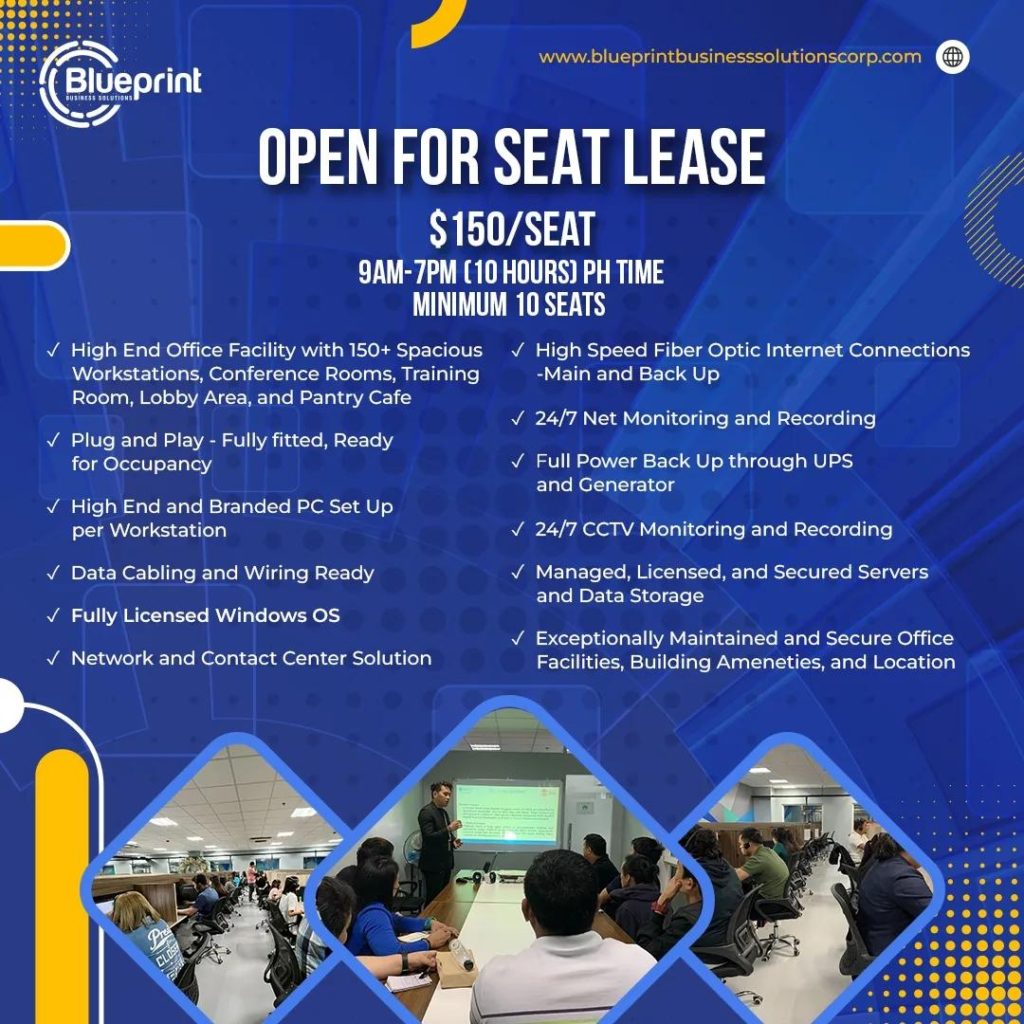
- Infrastructure Redundancy: Deploying dual commercial power grid connections backed by automated uninterruptible power supply (UPS) systems and on-site diesel generators.
- Network Diversification: Establishing multi-carrier fiber optic routing across disparate telecommunications providers to eliminate single points of failure.
- Proactive Risk Mitigation: Utilizing predictive analytics and automated monitoring dashboards to initiate protective protocols hours before adverse events materialize.
2. Multi-City Geographic Redundancy Across Philippine Delivery Hubs
The geographic layout of the Philippine archipelago provides a distinct strategic advantage for building resilient operational redundancies. Rather than consolidating all operational seats within a single metropolitan center, sophisticated BPO providers distribute capacity across established capital hubs and rapidly growing regional centers.
While Metro Manila remains the primary economic and financial hub, tier-2 and tier-3 cities such as Cebu and Bacolod offer world-class infrastructure and deep professional talent pools. Distributing operational teams across distinct geographical zones insulates global enterprises from regional weather anomalies, localized municipal power grid issues, or localized network disruptions.
Industry analyses from the Everest Group on Philippine BPO locations demonstrate that multi-city delivery models across Luzon and the Visayas significantly improve operational resilience while optimizing labor cost structures.
A multi-site geographic redundancy model typically operates across three strategic tiers:
- Metro Manila Hubs: Serving as primary management centers for complex corporate shared services, advanced analytics, and enterprise IT helpdesk operations.
- Cebu Operations Centers: Acting as active-active secondary delivery centers in the Central Visayas, providing immediate load-balancing and real-time operational failover.
- Bacolod and Regional Centers: Providing agile, dedicated operational capacity insulated from metropolitan transit congestion and capital-region infrastructure stress.
When localized disruptions impact one island region, automated traffic routing redirects operational queues instantaneously to alternate regional facilities without service degradation.
3. Automated Cloud Failovers and Virtualized Workspaces
Modern disaster recovery has evolved beyond physical alternate seating arrangements. Enterprise software platforms, customer contact centers, and back-office databases operate primarily within secure cloud environments. Consequently, effective disaster recovery relies on virtualized workplace infrastructure and automated data replication.
Leading Philippine BPO facilities deploy hybrid multi-cloud environments utilizing platforms like Amazon Web Services, Microsoft Azure, and Google Cloud. Customer data is encrypted in transit and at rest, with continuous snapshots mirrored across geographically separated data centers.
Insights published by McKinsey on building operational resilience reveal that companies migrating legacy business continuity frameworks to automated, cloud-based architectures cut recovery times from days to seconds while eliminating data loss during regional outages.
Technological failover capabilities embedded within enterprise BPO operations include:
- Virtualized Desktop Infrastructure (VDI): Enabling personnel to access identical, secure digital workstations from enterprise facilities or remote backup sites via encrypted connections.
- Automated Telephony Failovers: Cloud-based Interactive Voice Response (IVR) and Session Initiation Protocol (SIP) trunking systems that dynamically route inbound customer calls to unaffected sites.
- Immutable Snapshot Backups: Maintaining continuous off-site data replication to protect corporate records against ransomware attacks and system corruption.
4. Rigorous Governance, Compliance, and Regular DR Simulations
A continuity plan is only as reliable as its most recent live simulation. Enterprise procurement teams demand verifiable evidence that disaster recovery protocols function under real-world crisis conditions. Theoretical emergency manuals stored in binders do not satisfy enterprise vendor governance standards.
Top-tier Philippine BPO partners maintain international compliance certifications that mandate periodic, rigorous disaster recovery testing. These standards include ISO 22301 (Security and Resilience – Business Continuity Management Systems), SOC 2 Type II, and ISO 27001 for information security management.
Furthermore, international operational guidelines from Deloitte on global supply chain resilience highlight that continuous third-party auditing and unannounced crisis simulations are critical components for verifying vendor operational integrity.
Enterprise continuity governance protocols require:
- Bi-Annual Live Failover Drills: Conducting full-scale unannounced cutover simulations where live production traffic shifts entirely to secondary sites to measure actual RTO performance.
- Tabletop Scenario Testing: Simulating multi-vector crises—such as concurrent cyberattacks, submarine telecommunications cable cuts, and public transit strikes—with executive response teams.
- Comprehensive Audit Trails: Maintaining timestamped forensic documentation of all drill outcomes, system latencies, and corrective action items for client governance committees.
5. Strategic Benefits of Partnering with BPO Business Continuity Philippines Providers
Collaborating with established Philippine BPO providers transforms risk management from an administrative overhead burden into a sustainable competitive advantage. Developing and maintaining private enterprise disaster recovery sites domestically requires millions of dollars in capital expenditure, redundant software licenses, and dedicated facilities management teams.
Offshoring critical operations to a resilient Philippine partner allows enterprise organizations to inherit mature, audited operational infrastructure without bearing solitary capital investment costs. Highly educated, English-fluent professionals operate within enterprise-grade facilities designed specifically to guarantee uninterrupted service delivery.
By prioritizing BPO business continuity Philippines partnerships, global enterprises secure:
- Uninterrupted Brand Trust: Preserving customer satisfaction scores (CSAT) and Net Promoter Scores (NPS) by maintaining 24/7 service availability during market crises.
- Regulatory Compliance Assurance: Meeting stringent operational resilience mandates established by financial and healthcare regulatory bodies.
- Capital Efficiency: Eliminating domestic capital expenditures associated with private secondary data centers and dedicated disaster recovery real estate.
Guarantee Zero Downtime with Blueprint Business Solutions
Protecting mission-critical operations against unforeseen disruptions requires an enterprise partner with redundant infrastructure, agile delivery hubs, and a proven culture of operational resilience. Managing continuity planning internally can exhaust corporate resources, but partnering with an experienced BPO provider delivers immediate stability, compliance, and peace of mind.
At Blueprint Business Solutions, we provide custom enterprise back-office support, omnichannel contact center operations, and dedicated virtual staffing solutions built on resilient operational foundations. Based in the Philippines, our delivery centers integrate multi-carrier telecom diversification, automated cloud failovers, and geographic redundancy across key talent hubs. We ensure your critical customer interactions and back-office workflows remain operational around the clock, empowering your business to scale with confidence.
Ready to safeguard your operations and build a zero-downtime outsourcing framework?
Contact us today to schedule a free business consultation and learn how our enterprise BPO continuity solutions can protect and scale your business.